
White Powdery Mildew on Cannabis
What WPM Is, How It Spreads, and How to Treat White Powdery Mildew on Cannabis
For the record, we would throw out a plant that gets infected – prevention is KEY.
What is The Life Cycle Of White Powdery Mildew (WPM) On Cannabis
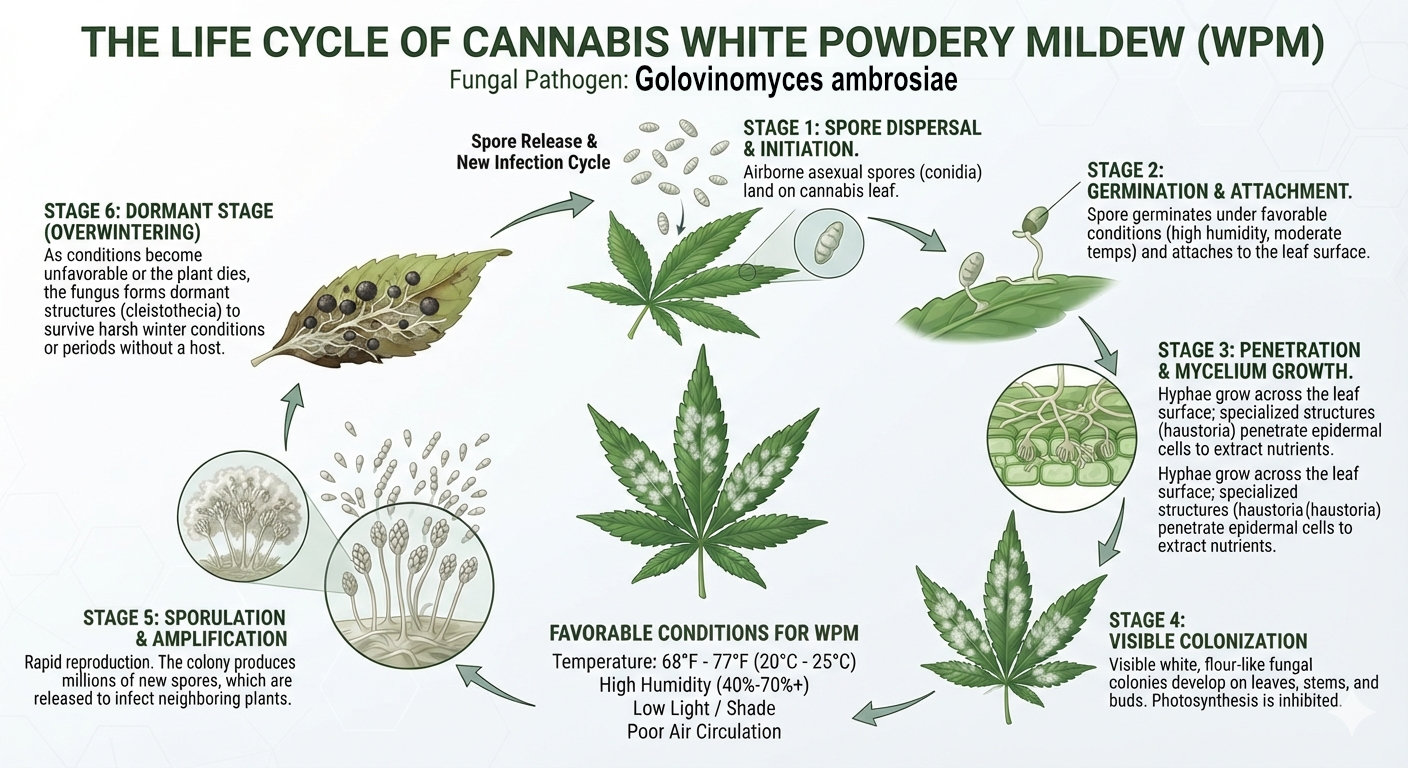
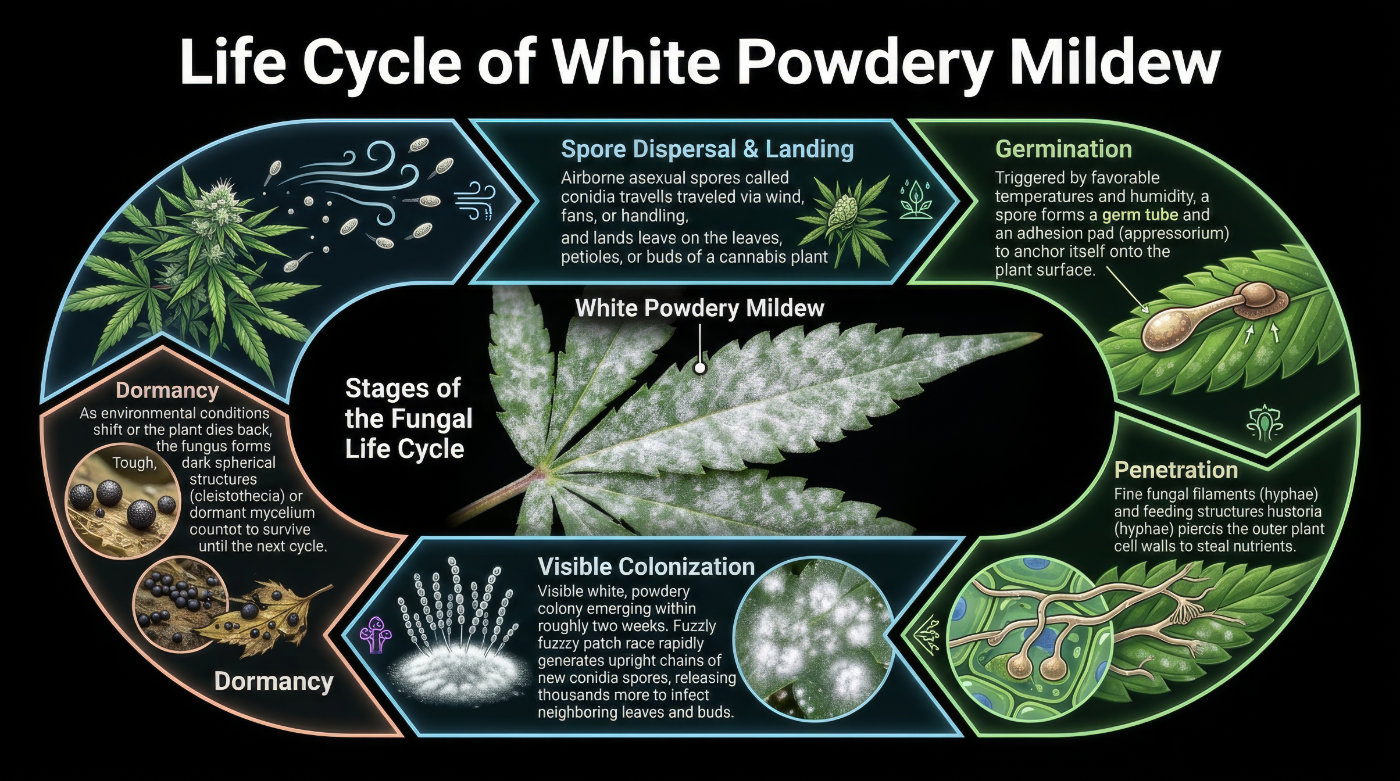
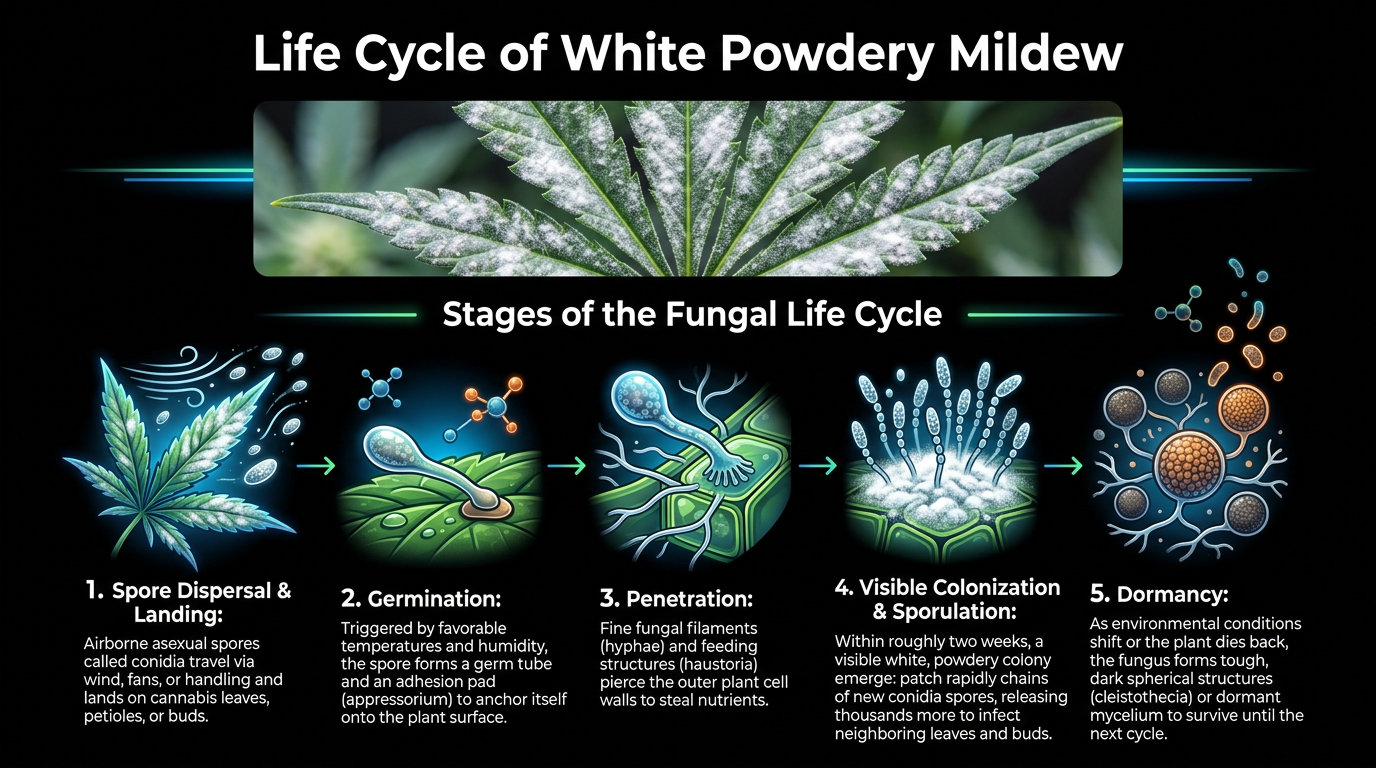
The life cycle of White Powdery Mildew (WPM) on cannabis consists of six main stages (see infographic below):
- spore dispersal (a spore lands on a leaf)
- germ tube attachment (humid conditions allow adhesion)
- tissue penetration via haustoria (penetrates leaf and feeds on juices)
- visible mycelium colonization (you can see the white patch)
- rapid sporulation (massive contagion)
- dormant overwintering via cleistothecia. (mostly happens outdoors)
What WPM Looks Like
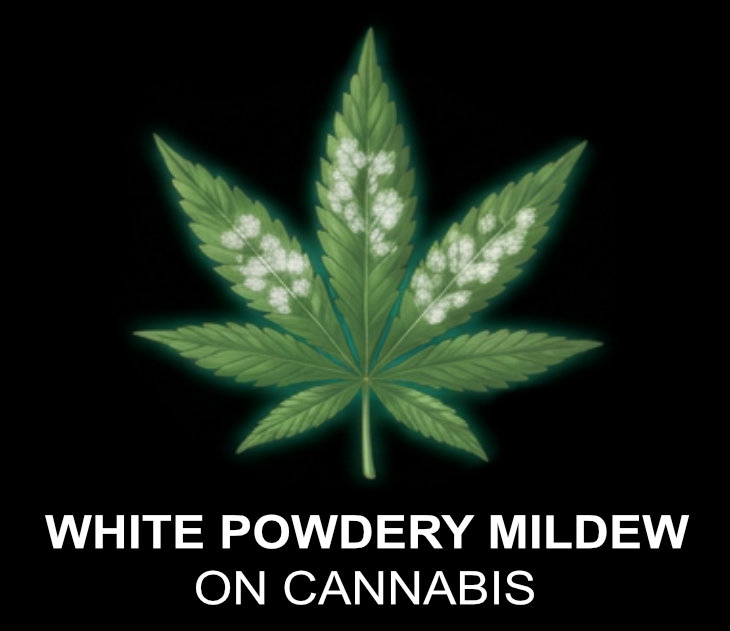
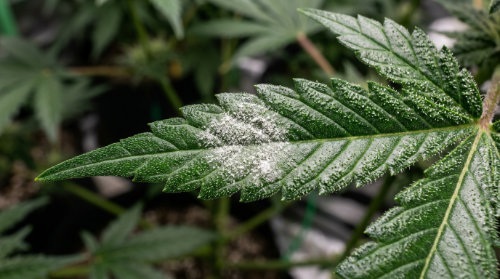
White Powdery Mildew (WPM) is a fungal disease that affects a wide variety of plants, including cannabis. It appears as distinctive white, powdery patches on leaves, stems and sometimes flowers.
Imagine if you spilled a bit of all-purpose flour on a leaf. WPM can also look like a patch of dust.
Powdery Mildew on Cannabis – The Big Picture
Environment is the Biggest Factor For WPM
(WPM spores can be ANYWHERE)
Powdery mildew is strongly influenced by the environment.
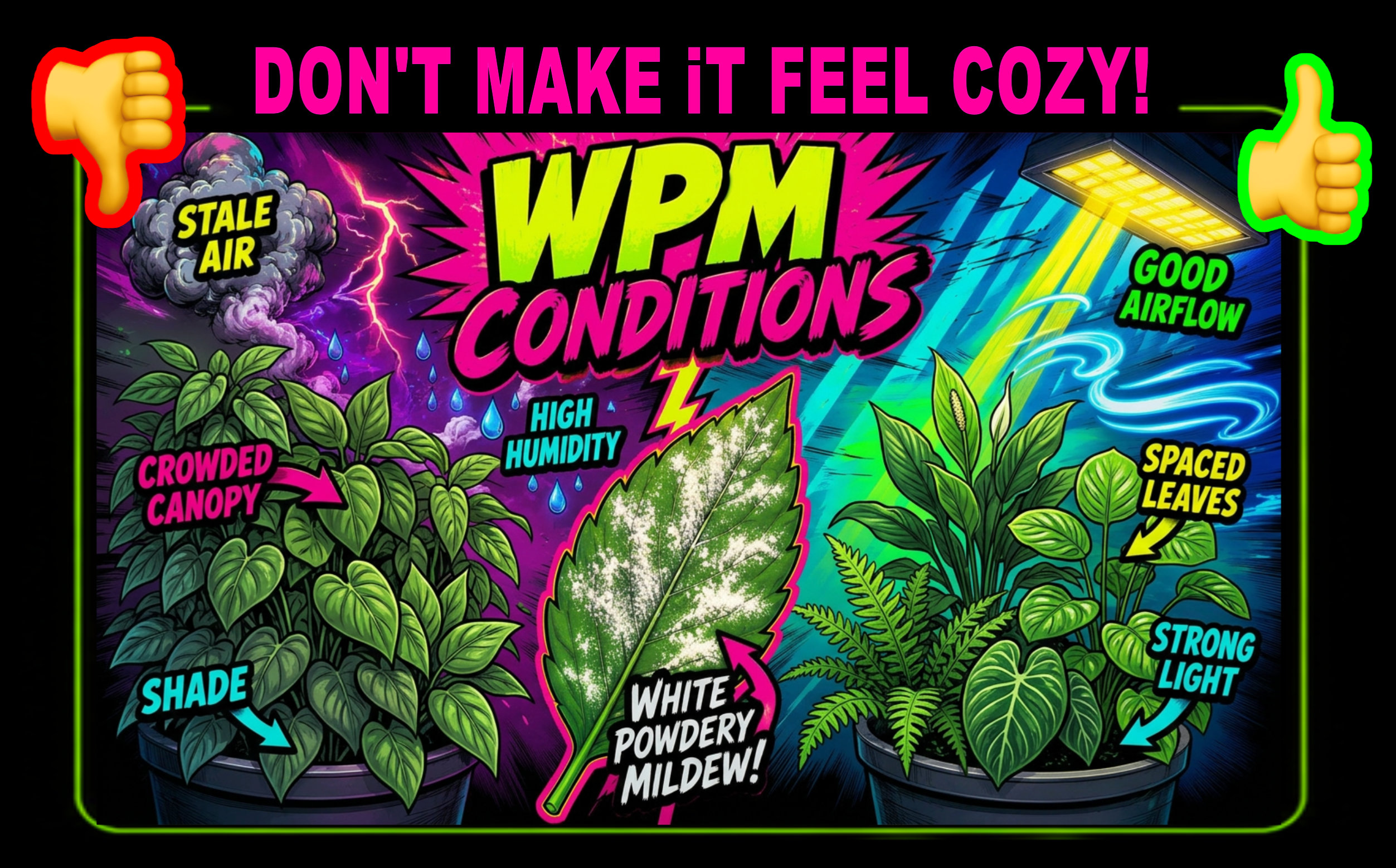
Dark, humid, poorly ventilated areas of a plant canopy can create ideal conditions for WPM to establish and spread.
Dense foliage, stagnant air, high humidity and shaded leaves can all contribute to an environment where powdery mildew is more likely to become a problem.
There are several ways to treat powdery mildew once it appears, including removing infected plant material, improving airflow and environmental conditions, and using appropriate fungicidal or contact treatments. However, prevention is considerably easier than trying to manage an established infestation.
One important point is often misunderstood: powdery mildew does not necessarily require a wet leaf to infect a plant. Unlike many fungal diseases, powdery mildew can germinate and infect under humid conditions without free water sitting on the leaf surface.
This makes the microclimate around the plant particularly important. The humidity measured by a hygrometer may not accurately represent the humidity immediately surrounding a dense canopy, where transpiration, limited airflow and shading can create much more favorable conditions for WPM.

Powdery Mildew on Cannabis – The Big Picture
What Is Powdery Mildew on Cannabis?
Powdery mildew is a fungal plant disease caused by members of the powdery mildew group of fungi. It is not a single species; different powdery mildew fungi infect different host plants.
Several powdery mildew species have been documented on cannabis and hemp, including species in the genera Golovinomyces and Podosphaera.
The disease gets its name from its characteristic appearance. The fungus produces a white, powdery growth on the surface of infected plant tissue, usually beginning as small patches that can gradually expand.
Powdery mildew may be found on:
- Leaves
- Petioles
- Stems
- New growth
- Flowers
The fungus primarily grows on the surface of the plant while producing specialized structures called haustoria, which penetrate plant cells and allow it to obtain nutrients.
That white powder is therefore not simply a residue or surface contamination. It is visible fungal growth.
The Life Cycle of WHITE POWDERY MILDEW
Fungal Pathogen: Golovinomyces ambrosiae
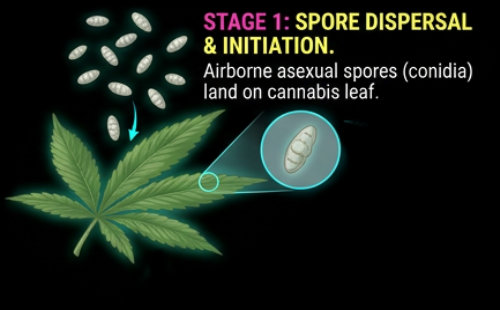
STAGE 1: SPORE DISPERSAL & INITIATION.
Airborne asexual spores (conidia) land on cannabis leaf.
The microscopic, barrel-shaped asexual spores are called conidia. They are completely dry and incredibly light, allowing them to drift on even the slightest breeze or indoor fan current. Unlike many other garden molds, these spores do not need a droplet of standing water to trigger an infection; they can landing and start resting right on the dry leaf surface
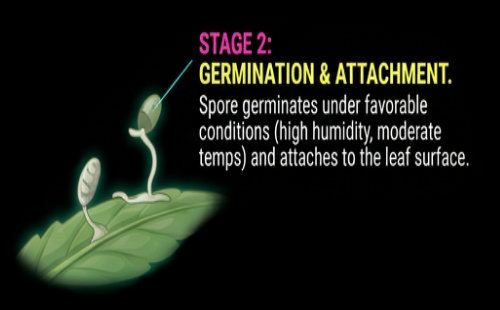
STAGE 2: GERMINATION & ATTACHMENT.
Spore germinates under favorable conditions (high humidity, moderate temps) and attaches to the leaf surface.
Once the spore lands, it senses the relative humidity of the microclimate directly hugging the leaf surface. If it is favorable, the spore sprouts a germ tube within hours. This tube releases a natural biological “glue” (extracellular matrix) to firmly cement itself to the slick waxy layer (cuticle) of the cannabis leaf so it cannot be easily shaken or blown off
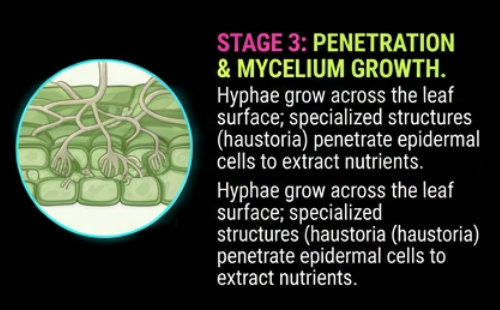
STAGE 3: PENETRATION & MYCELIUM GROWTH.
Hyphae grow across the leaf surface; specialized structures (haustoria) penetrate epidermal cells to extract nutrients.Hyphae grow across the leaf surface; specialized structures (haustoria (haustoria)) penetrate epidermal cells to extract nutrients.
This is where the fungus acts like a true parasite. It pierces the outer skin of the leaf using physical pressure and specialized enzymes. It builds root-like feeding tubes called haustoria inside the living plant cells.
Think of these as tiny straws: the fungus pumps out digestive proteins and drinks up the plant’s hard-earned sugars and nutrients without actually killing the cell right away.
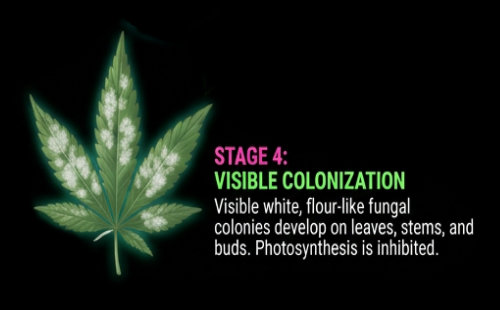
STAGE 4: VISIBLE COLONIZATION
Visible white, flour-like fungal colonies develop on leaves, stems, and buds. Photosynthesis is inhibited.\
What you see as a white, flour-like patch is a massive web of fungal threads called mycelium growing over the outside of the leaf.
Because this white blanket physically covers the green leaf tissue, it blocks sunlight. This severely cuts down the plant’s ability to run photosynthesis, starving the plant of energy and causing leaves to turn yellow, curl up, or eventually drop off.
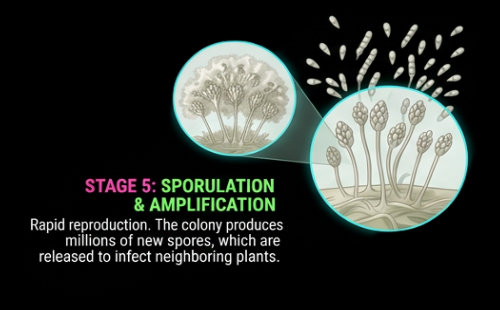
STAGE 5: SPORULATION & AMPLIFICATION
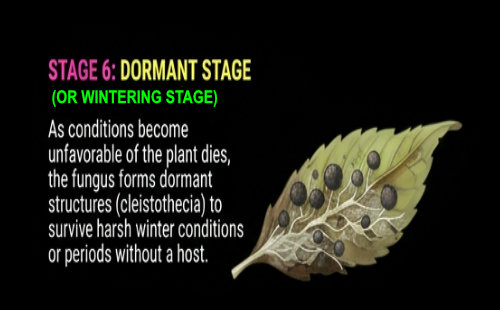
STAGE 6: DORMANT STAGE (OVERWINTERING)
When winter hits, the crop is harvested, or the plant dies, the fungus switches from asexual reproduction to sexual reproduction to survive. It fuses together to build dark, thick-walled protective shells called cleistothecia (also known as chasmothecia). These rugged little survival pods shield the fungal DNA from extreme freezing temperatures, drought, and standard surface cleanings, lying completely dormant until a new host plant appears next spring.
WPM White Powdery Mildew Remedies
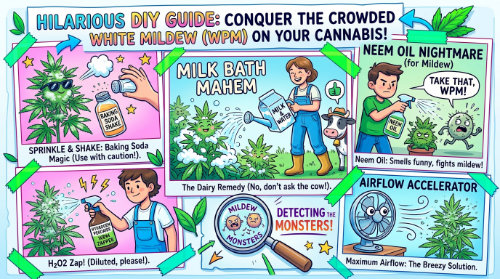
There are a lot of home remedies as well as commercial products available for treating WPM.
Some common remedies might make you laugh: everything from milk (yes, cow’s milk) to baking soda….
But frankly, our suspicion is that any treatment is so unlikely to fully eradicate an infestation of White Powdery Mildew, that you might as well throw away your plant if you see it on your plant.
That’s our approach. Buh-bye.
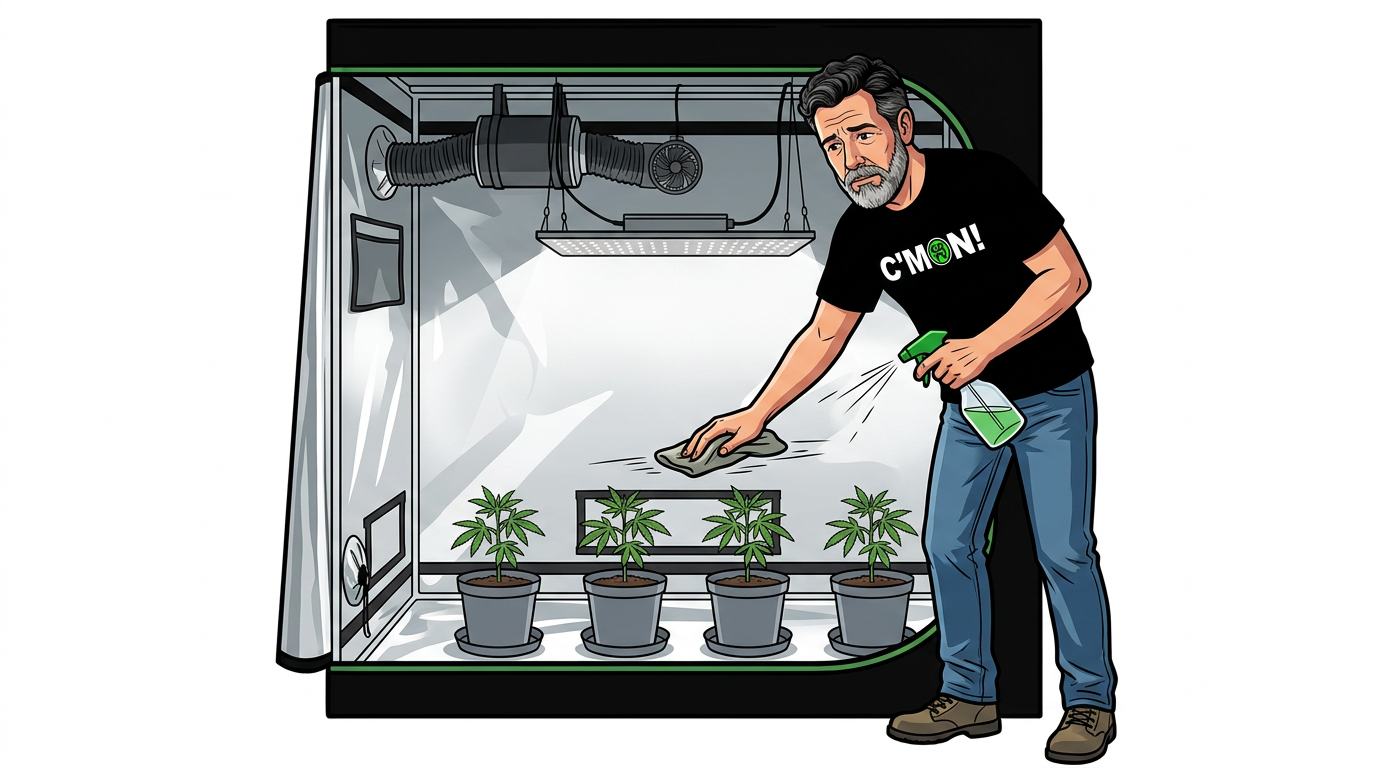
Here are two home-remedies that we used – and neither worked to eliminate the White Powdery Mildew. To be fair, the infection in our four plants was not severe by any means, just a leaf here and a leaf there, but each time we plucked, sprayed, and wiped down the tents, we would find it again. Just a tiny patch here or there, but we decided to cull the whole grow. it was a heartbreak.
Don’t Just Treat the Leaves
Once WPM has appeared, don’t think of it as something that’s living only on the one leaf where you spotted it.
Inspect and clean the entire growing environment.
That means considering:
- All plants, not just visibly affected plants
- Leaves and stems throughout the canopy
- Tent walls and other appropriate surfaces
- Fans and equipment
- Tools
- Plant debris
- Anything that may have contacted infected material
Because your objective isn’t simply to make one white spot disappear.
You’re trying to reduce the amount of viable inoculum in the entire growing environment and break the cycle of reinfection.
As mentioned above, this didn’t work – it seemed to help and perhaps it would have worked if we had kept treating regularly, but we decided that there was too much risk of going into flower stage with the White Powdery Mildew.
It’s dangerous to eat or inhale the cannabis if infected with WPM. It’s hard to get a straight answer about it when it’s in flower, but we feel pretty strongly that it’s garbage and that it’s all but impossible to get rid of it even in veg stage but even more so in flower stage.
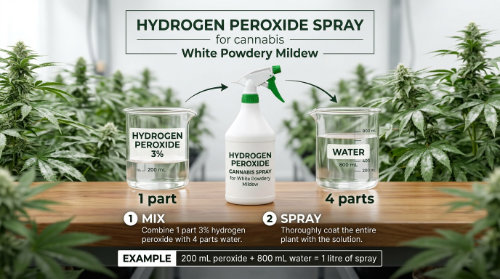
Hydrogen Peroxide Spray
1 part 3% hydrogen peroxide
+ 4 parts water
Mix and use as a spray on the plants and growing-area surfaces as appropriate. The goal is to address visible fungal growth as well as potential contamination around the growing environment.
Example: 200 mL peroxide + 800 mL water = 1 litre of spray.
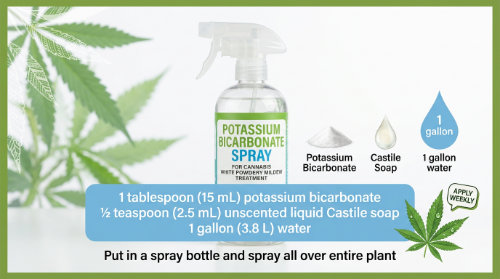
Potassium Bicarbonate Spray
1 tablespoon potassium bicarbonate
+ 1 teaspoon unscented liquid Castile soap
+ 1 gallon (3.8 L) water
Mix thoroughly and apply to the plant surfaces and canopy, aiming for thorough coverage rather than treating only the leaves where WPM is visible.